Define the observation and decision
Model drift describes changing input or performance conditions after deployment. New seasons, sensors, processing versions or land management can shift the relationship learned during training. Successful operation of the software does not establish continued prediction validity.
For operational model-drift evidence, start with a precise question. State the decision and the quantity before comparing software settings. Identify who will use the result, the geographic units they recognize and what evidence would change an inspection or analysis. Write down the target condition and plausible alternative explanations. This makes it possible to judge whether the method’s actual observation can answer the question. A fine-looking map is not sufficient when the output represents a proxy with a different meaning. Retain a short assumptions register so later reviewers can distinguish measured inputs, model choices and interpretation.
Match data support to the method
The measurement basis for operational model-drift evidence matters throughout interpretation. A satellite model learns a relationship between defined inputs and reference targets under sampled conditions. It does not create information absent from the sensor or correct inconsistent labels automatically. Define class meanings or continuous target units before selecting an algorithm. Match the training reference to image time and spatial support, and record uncertainty or disagreement in the labels. Identify the intended deployment region, season and acquisition conditions. These choices determine what generalization should be tested and prevent an impressive development score from being mistaken for evidence that the model is ready for a different operational setting.
Prepare a traceable analysis
Track input distributions, missingness and source versions alongside sampled reference outcomes. Define review triggers tied to practical errors rather than arbitrary distribution shifts alone. Preserve model and data versions for each run.
Preparation for operational model-drift evidence should preserve the following evidence. Prepare a reproducible predictor manifest with source dates, band order, units, masks and preprocessing. Separate evaluation before feature selection, scaling, tuning or patch extraction can leak information across the split. Use geographic or temporal partitions appropriate to deployment, and compare a simple baseline. Preserve model parameters, random seed where applicable and software versions. Test realistic missing-data and difficult-image conditions. A training run that converges or completes is only one technical step; its output must still be evaluated against independent evidence and the consequences of the intended decision.

Test a representative pilot
A pilot for operational model-drift evidence should address the actual receiving workflow. Begin with a representative pilot that contains ordinary conditions and difficult exceptions. Include relevant boundaries, mixed surfaces, missing observations and known reference locations. Save a few manually checked numerical examples alongside source metadata. Compare the result with an independent reader or calculation where practical. The pilot should test the complete path from source selection through export, since a correct formula can still be undermined by wrong units, band order or validity handling. Once the pilot is understood, retain it as a reference for later revisions.
Recognize topic-specific interpretation risks
A distribution shift may be harmless, while stable-looking inputs can accompany changed labels. Automatically retraining on unreviewed predictions can reinforce errors. Comparing only the most confident cases can hide degradation.
Review of operational model-drift evidence should continue after the calculation completes. Assess more than one overall score. Report class-specific confusion for classification or bias and error patterns for regression, with sample support and geographic or temporal scope. Evaluate difficult and rare targets deliberately. Keep model scores distinct from calibrated probabilities and preserve an unsupported-domain flag where appropriate. Inspect representative errors and compare the operational review burden created by false alarms. When transferring or updating a model, evaluate the candidate on untouched data and retain the previous version. Monitoring remains reliable only when changing inputs and outcomes are reviewed, rather than assuming initial performance persists indefinitely.
Work through an illustrative example
For an illustrative agricultural model, a new crop variety changes canopy timing. Predictions remain confident while independent field checks reveal declining recall, prompting a targeted review.
The reasoning example for operational model-drift evidence has a deliberately limited role. The example in this article is illustrative and is not a reported project outcome, accuracy claim or performance guarantee. Replace its assumptions with measured project values before using the reasoning operationally. Keep units, observation dates and the relevant denominator visible. If a reasonable alternative mask, reference or parameter changes the decision, report that sensitivity and obtain better evidence where practical. Extra decimal places do not resolve uncertainty in what was observed. Retain unresolved cases explicitly instead of selecting the parameter that produces the most persuasive narrative.
Evaluate against independent evidence
Maintain independent recurring checks across classes and regions. Compare current and reference performance with uncertainty. Evaluate a candidate replacement on untouched data before adoption.
Validation of operational model-drift evidence should be designed before final parameter selection. Independent evaluation should represent the population and conditions in which the result will be used. Separate observations used to choose parameters or train a model from those used to assess performance. Include difficult non-target cases as well as obvious targets, and retain information about missing or unobservable areas. Match reference timing and spatial support as closely as practical. When disagreement occurs, investigate both the analysis and the reference evidence. A reference measurement can have uncertainty too, so forcing it to match the map is not a valid correction strategy.
Report uncertainty at the useful scale
For operational model-drift evidence, a result must retain its demonstrated scope. Review uncertainty at the scale of the intended decision. Pixel spacing, effective sensor support, processing neighborhoods and management units can differ substantially. Many resampled pixels do not create many independent observations. For an area summary, preserve valid coverage and exclusions; for a candidate feature, preserve detection confidence and source date. Separate systematic effects from local variation where evidence permits. A small average error does not rule out a consequential bias in a rare class, a particular material or an underrepresented region. Report the scope demonstrated by the evaluation.
Deliver usable GIS and analysis evidence
Export drift indicators, reviewed outcomes and model-update decisions. ITSensing recurring workflows should preserve evidence that the model remains suitable, rather than equating completed jobs with validated monitoring.
The handover for operational model-drift evidence should remain understandable outside the authoring environment. Deliver an accessible overview together with the relevant geospatial data and a concise data dictionary. Retain stable identifiers, source references, observation dates, processing version, coordinate reference and quality fields. Explain unknown areas and the next useful check in an exception register. Ask the receiving analyst to locate a sample item, identify its evidence and interpret its limitations. That practical review can reveal missing context that a file-integrity check cannot detect. Preserve the reason for revisions so a later change can be traced to new observations or a changed method.
Evaluate the ITSensing workflow with real inputs
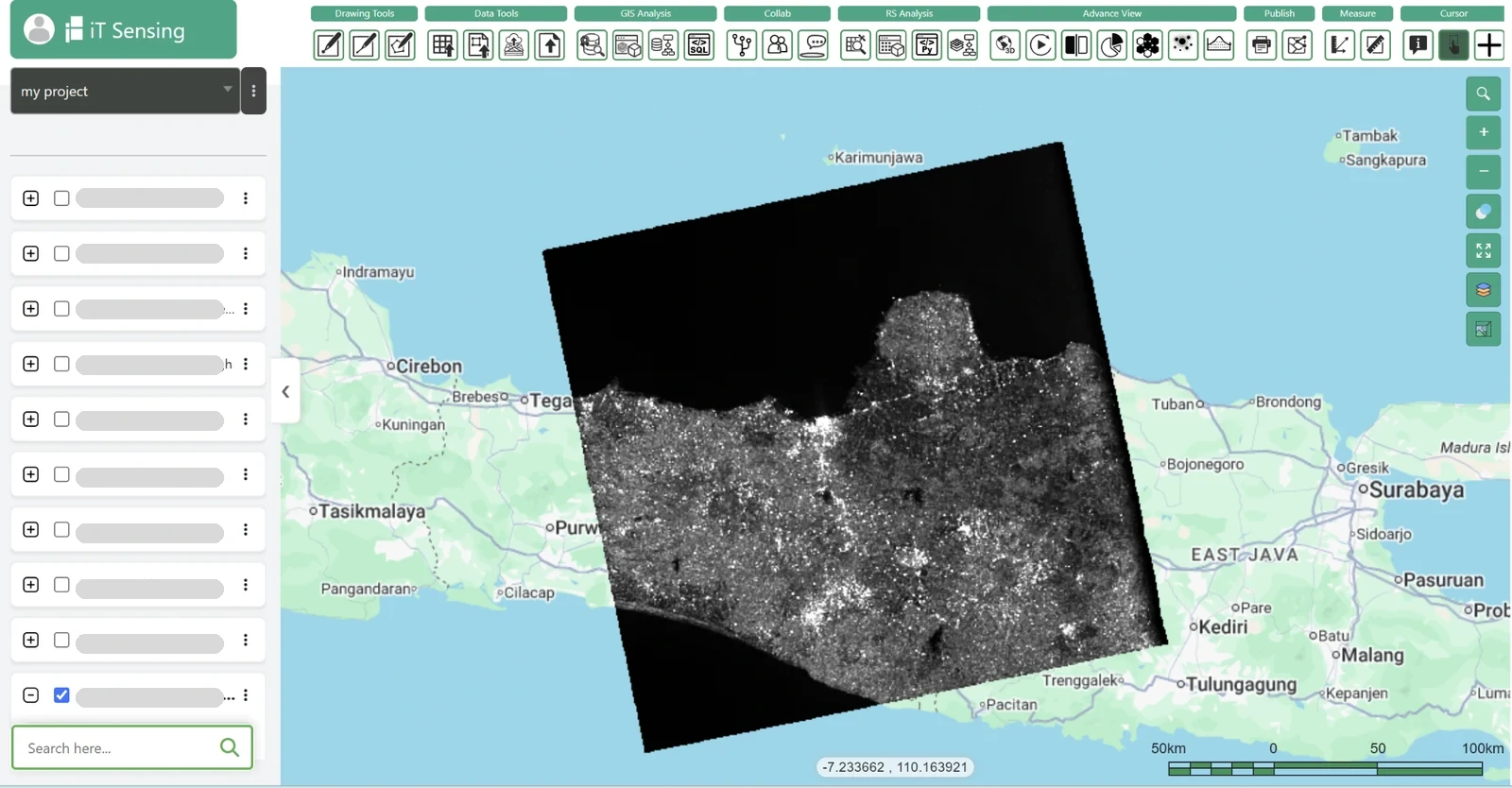
When assessing cloud remote sensing software for operational model-drift evidence, use a documented pilot. Use the product comparison to test a complete workflow with representative data. ITSensing presents a cloud workspace for satellite discovery, raster and spectral analysis, machine learning, GeoAI, model building and Python-based work. Those broad capabilities do not establish that every specialized method described here is a native button or that every external service connects directly. Check the actual documented tool, supported input and export path. Retain pilot evidence and independent validation before choosing a recurring workflow. A product link is an entry point for evaluation, while scientific interpretation remains tied to the data and method.