Define the observation and decision
A reproducible pipeline preserves the inputs, transformations and parameters needed to explain a result. A screenshot of a successful run is insufficient because product revisions, masking choices and software behavior can alter later outputs.
For repeatable imagery processing runs, start with a precise question. State the decision and the quantity before comparing software settings. Identify who will use the result, the geographic units they recognize and what evidence would change an inspection or analysis. Write down the target condition and plausible alternative explanations. This makes it possible to judge whether the method’s actual observation can answer the question. A fine-looking map is not sufficient when the output represents a proxy with a different meaning. Retain a short assumptions register so later reviewers can distinguish measured inputs, model choices and interpretation.
Match data support to the method
The measurement basis for repeatable imagery processing runs matters throughout interpretation. Optical preprocessing should preserve the distinction between the instrument observation, the corrected product and a derived analysis layer. Product collections can differ in calibration, geometry, masks and encoding. Start with authoritative metadata and retain the original identifiers, acquisition time and processing level. Define the quantity and spatial support needed by the decision before choosing a convenient output grid. A clean natural-color display can conceal numeric or quality problems, while an unattractive raw view can still contain valid quantitative information. The purpose of preparation is a traceable and suitable measurement, not only a consistent-looking image.
Prepare a traceable analysis
Create a manifest containing source identifiers, acquisition dates, processing levels, band mappings, scale rules, masks and output grid. Record software and model versions with parameters. Keep an immutable reference example for checking future changes.
Preparation for repeatable imagery processing runs should preserve the following evidence. Build the preprocessing chain in a deliberate order and avoid repeated unnecessary transformations. Check band identities, scale and offset, saturation and nodata before derived expressions. Use the correct quality specification for the exact product and preserve rejection reasons. Choose a reference grid with explicit CRS, origin, resolution and extent. For any interpolation or aggregation, document how valid and invalid observations contribute. Inspect a small representative pilot, including edges and difficult terrain, before processing the full area. A successful job completion establishes that the calculation ran; it does not establish physical comparability or suitability for the next analytical step.
Test a representative pilot
A pilot for repeatable imagery processing runs should address the actual receiving workflow. Begin with a representative pilot that contains ordinary conditions and difficult exceptions. Include relevant boundaries, mixed surfaces, missing observations and known reference locations. Save a few manually checked numerical examples alongside source metadata. Compare the result with an independent reader or calculation where practical. The pilot should test the complete path from source selection through export, since a correct formula can still be undermined by wrong units, band order or validity handling. Once the pilot is understood, retain it as a reference for later revisions.
Recognize topic-specific interpretation risks
A processing tool can change defaults after an update. Reusing a file name can obscure revised input data, and a model name can hide retraining. Reproducibility therefore depends on explicit identities and provenance rather than memory of the workflow.
Review of repeatable imagery processing runs should continue after the calculation completes. Review preparation in relation to the downstream task. Small alignment errors matter strongly at narrow boundaries, while subtle atmospheric residuals matter for weak spectral contrasts. Composites and harmonized layers need clear temporal and sensor provenance. Inspect accepted and rejected observations, because selective coverage can bias a summary even when every retained pixel is individually reasonable. Compare alternative defensible parameters where the decision could change. Keep unsupported locations explicit and retain intermediate evidence sufficient to investigate anomalies. Report how preprocessing influences the final metric rather than treating it as an invisible technical stage whose settings do not affect interpretation.
Work through an illustrative example
In an illustrative rerun, a field’s mean index changes even though the date is unchanged. The manifest reveals a revised cloud buffer and a new product version. That explanation is more useful than treating the difference as unexplained ecological change.
The reasoning example for repeatable imagery processing runs has a deliberately limited role. The example in this article is illustrative and is not a reported project outcome, accuracy claim or performance guarantee. Replace its assumptions with measured project values before using the reasoning operationally. Keep units, observation dates and the relevant denominator visible. If a reasonable alternative mask, reference or parameter changes the decision, report that sensitivity and obtain better evidence where practical. Extra decimal places do not resolve uncertainty in what was observed. Retain unresolved cases explicitly instead of selecting the parameter that produces the most persuasive narrative.
Evaluate against independent evidence
Re-run a representative pilot and compare expected numeric summaries and masks. Review material differences rather than requiring byte identity where metadata timestamps differ. Verify that a receiving analyst can follow the manifest and identify unsupported areas.
Validation of repeatable imagery processing runs should be designed before final parameter selection. Independent evaluation should represent the population and conditions in which the result will be used. Separate observations used to choose parameters or train a model from those used to assess performance. Include difficult non-target cases as well as obvious targets, and retain information about missing or unobservable areas. Match reference timing and spatial support as closely as practical. When disagreement occurs, investigate both the analysis and the reference evidence. A reference measurement can have uncertainty too, so forcing it to match the map is not a valid correction strategy.
Report uncertainty at the useful scale
For repeatable imagery processing runs, a result must retain its demonstrated scope. Review uncertainty at the scale of the intended decision. Pixel spacing, effective sensor support, processing neighborhoods and management units can differ substantially. Many resampled pixels do not create many independent observations. For an area summary, preserve valid coverage and exclusions; for a candidate feature, preserve detection confidence and source date. Separate systematic effects from local variation where evidence permits. A small average error does not rule out a consequential bias in a rare class, a particular material or an underrepresented region. Report the scope demonstrated by the evaluation.
Deliver usable GIS and analysis evidence
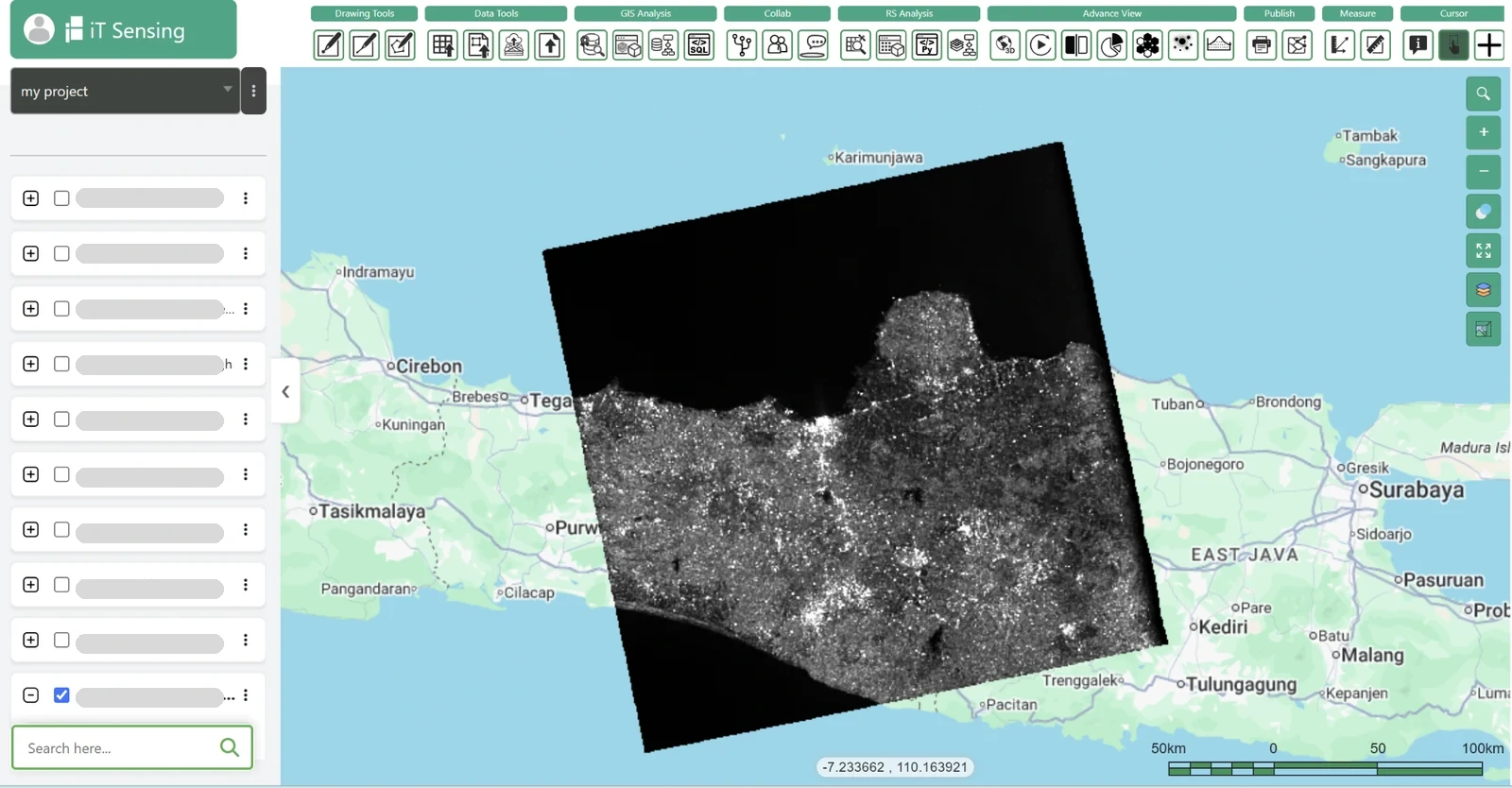
Export analysis parameters, source references and exception logs with the geospatial outputs. ITSensing’s available model builder and Python workflow can be evaluated for this process, while reproducibility should be demonstrated on actual retained inputs.
The handover for repeatable imagery processing runs should remain understandable outside the authoring environment. Deliver an accessible overview together with the relevant geospatial data and a concise data dictionary. Retain stable identifiers, source references, observation dates, processing version, coordinate reference and quality fields. Explain unknown areas and the next useful check in an exception register. Ask the receiving analyst to locate a sample item, identify its evidence and interpret its limitations. That practical review can reveal missing context that a file-integrity check cannot detect. Preserve the reason for revisions so a later change can be traced to new observations or a changed method.
Evaluate the ITSensing workflow with real inputs
When assessing cloud remote sensing software for repeatable imagery processing runs, use a documented pilot. Use the product comparison to test a complete workflow with representative data. ITSensing presents a cloud workspace for satellite discovery, raster and spectral analysis, machine learning, GeoAI, model building and Python-based work. Those broad capabilities do not establish that every specialized method described here is a native button or that every external service connects directly. Check the actual documented tool, supported input and export path. Retain pilot evidence and independent validation before choosing a recurring workflow. A product link is an entry point for evaluation, while scientific interpretation remains tied to the data and method.